Jennifer Shields, AMI 3–6 Trainer
Imagine walking into a restaurant and having the waiter tell you exactly what to eat, and how quickly.
No choice in the selection, no consideration of your individual tastes or preferences. Even if this food was healthy, how might you feel? Imagine doing this for every meal, year after year.
This is how children are treated in traditional school.
Sit exactly here at this moment. Listen and learn what I, the teacher, give you, now. Only this. Because I say you need this. Everyone must do the same thing I say at the same time. I, the teacher, will judge if you have learned well, according to my standards.
Now, let’s imagine those children in a primary Montessori environment. They enter and are greeted warmly, individually, by the teacher. They have time to settle in, greet each other, perhaps checking out the bird feeder on the window. And all around them are enticing, beautiful materials. The children may look at anything they wish, move about as they like, as long as it does not disturb others. They respond to their own inborn, healthy drives that urge them to learn and grow into their own, unique self.
“Oh!,” a three-year-old might think, “the handwashing. Janet showed me that. I want to do that.” She can put on the apron customized for this activity. This is a sign to herself and others, I am going to do this. She looks at the materials and thinks: “What comes next? Hmmm, I know I need water…the pitcher!” A pottery jug is colour coded with the other materials. “I need to get water.” She walks to the child-height sink and fills the pitcher. And then fills the basin, soaping her hands, and scrubbing her nails. She rinses her hands, dries them. She has clean hands but now what? “Oh, I need to leave this for the next person.” She empties the soapy water using a bucket and rinses the basin, dries the materials, hangs up the towel. “Now I’m done. Look at my clean hands. I can put the apron back on the hook. Someone else might want to do this.”
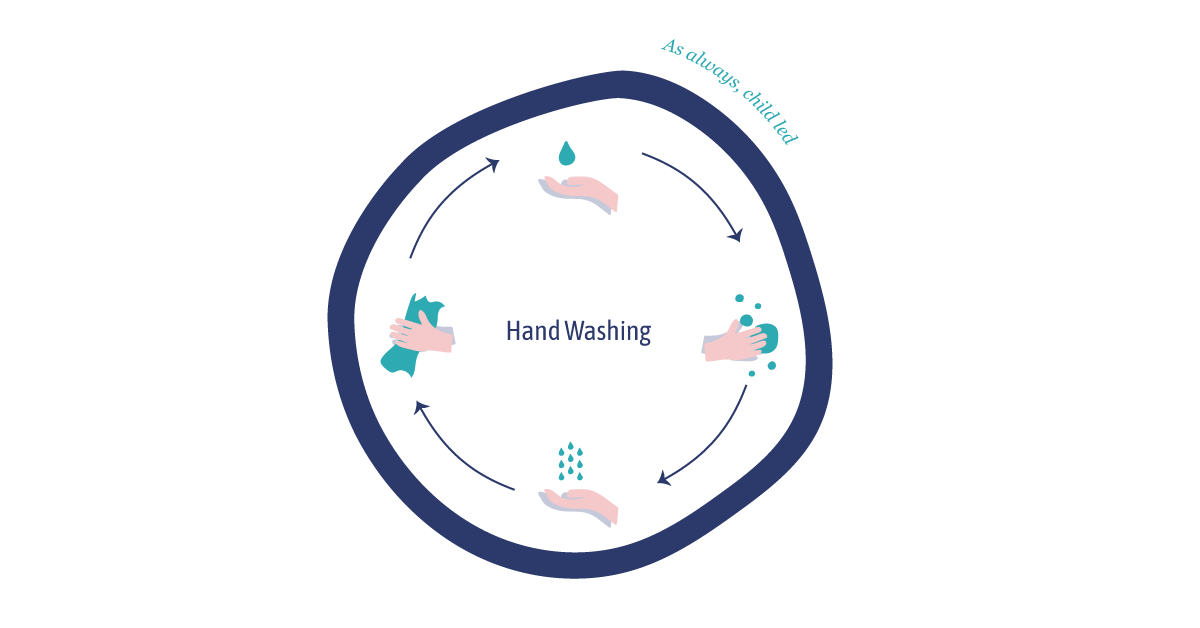
It may seem mundane: washing one’s hands. But, from this freedom to choose interesting, age-appropriate movements, she enters into concentration: true engagement. She experiences independence. “I can do things on my own. I can use beautiful objects. I can make mistakes – maybe I spilled water or got soap on the wall. That’s ok! I can fix it.” These are profound developmental experiences.
Over time, these choices might be tracing geometric shapes, counting every golden bead in a chain made of one thousand beads, writing an original story with a set of letters, exploring shapes she can make with a set of wooden triangles. There are hundreds of lessons, introduced in a particular sequence, according to a child’s individual development. And from those she has seen (choice within limits), she can pick which she wants to do. Every day, over three years. Within a three-hour, uninterrupted morning.
The key is that she CHOOSES for herself. The entire experience would be transformed if an adult told her to do it, rushed her, corrected her, interfered. The children surprised Maria Montessori. They wanted to do new things, hard things. If they were allowed to choose from activities that the adult had carefully prepared, they would choose well for themselves. They would repeat. They would self-correct. And they would be joyful. They would be kinder.
Montessori wrote about the teacher, enticing the child, but never forcing or surveilling:
“When these children from the streets and from the asylum entered my school they were greeted with hearty manifestations of welcome and with genuine cordiality. For the first time they were made to feel that they were wanted and desired. There was not the slightest suggestion of suppression or strict vigilance…I was like a [merchant] in a bazaar. Upon the arrival of a customer for whom he has anxiously awaited, he showers him with compliments and with courtesy, sings the praises of his wares, and abides the opportune moment…when the customer shall become interested in some particular article.”
[Emphasis added] (Maria Montessori, Creative Development in the Child, Vol. 1, p. 264.)
A child who gets to spend years in a primary classroom, has this pivotal experience of choice, over and over again, throughout his days. She comes to know herself. What do I like? What can I do? She never feels judged or rushed.
The teacher builds a relationship with each child, supporting their individuality, guiding subtly when needed. The teacher prepares a rich environment and connects the child with presentations of the materials. Presentation has the word present in it. The child can do what she wishes with this present. She will choose to use it when she decides to, for how long, and where in the room.
Choice is a cornerstone of the human experience. We adults make choices. I can choose what is right and good for me. That is my birthright. A child who has these experiences of autonomy, joy, and self-discovery is forming their personality. “Who am I? I have agency. I am coming to know myself.” This, Montessori says, is the foundation for an independent, interdependent, moral adult and a peaceful society.
So, let us help the children in our care to make choices. Little by little, we are building strong, moral human beings who may build a peaceful world for us all.
ABOUT THE AUTHOR
Jennifer Shields has been a primary teacher-trainer since 2010. She is a lecturer, examiner, and consultant for the Association Montessori Internationale. She taught primary children for over ten years and now enjoys sharing her experience as a Director of Primary Training at Washington Montessori Institute in Maryland, USA. Jennifer earned her 3-6 AMI Diploma at Ohio Montessori Training Institute. Twenty years later, she earned her 0-3 Diploma from The Montessori Institute in Denver. Jennifer holds a BA in English from Georgetown University,
where she graduated summa cum laude. She earned an MEd from Cleveland State University. Jennifer has trained teachers at WMI, nationally, and internationally. Jennifer enjoys working with parents, assistants, coaching and mentoring teachers, especially those in the public sector.